The Art of Receiving & Giving

- By Alexandra Heynatz, Certified Wheel of Consent® facilitator
Many of us have well developed relational muscles around giving, holding space, and responding to others' needs. Like me, you may have given a lot of attention to strengthening your capacity for attunement, care and compassion, personally and even professionally.
But genuine mutuality in relationship equally requires us to practise the other side of the equation: identifying and expressing what we want, noticing and trusting our own limits because they matter, and letting in nourishment. For many of us, these muscles are underused, unfamiliar, and can feel incredibly vulnerable. It's deeply tender to claim what we really want!
This is one reason why the Wheel of Consent® is such a powerful practice. It offers a simple, embodied map for discerning the felt difference between receiving and giving. We start to notice when we've moved into people pleasing, over-functioning or numbing our own needs - in the simple experiments of the Wheel - and over time, in our daily interactions in love, sex, work, and community. We start to catch the places we are tempted to say yes even when our body has said no… and in these moments, slow down: ‘Am I really willing to do this?’, ‘Where is my limit?’, ‘Isn’t it my turn to receive?’
In this work, we privilege the instinctive intelligence of the body. Sensation points the way to our limits, desires, and what brings us alive. Slowness and compassion are our necessary companions here. Most of us have adapted survival strategies to feel safe and belong: this makes sense even when these ways of being are no longer helpful or required.
Having a supportive and kind practice space to strengthen our capacity to listen, to trust what we're noticing, and to bring ourselves back into connection is deeply important. For me, the Wheel revealed just how much of my life had been spent in the giving half, not choicefully, but habitually. No wonder I was so tired… If you spend a lot of your time caring for others or managing complex relational dynamics, maybe you recognise this place too?
Activist and writer Rae Johnson talks about somatic practice as ‘embodied activism’ and how a disconnected relationship with the felt sense of the body is one of the patterns oppressive systems rely on[i]. It's easier to ignore our own needs, push through exhaustion, and stay in over-functioning when we've stopped being able to feel ourselves, right? Of course, no framework in isolation will dismantle oppression. But I do believe that turning toward ‘the art of receiving and giving’[ii] (Betty Martin's words) builds a relational ecology more grounded in collective care and more attuned to what really matters.
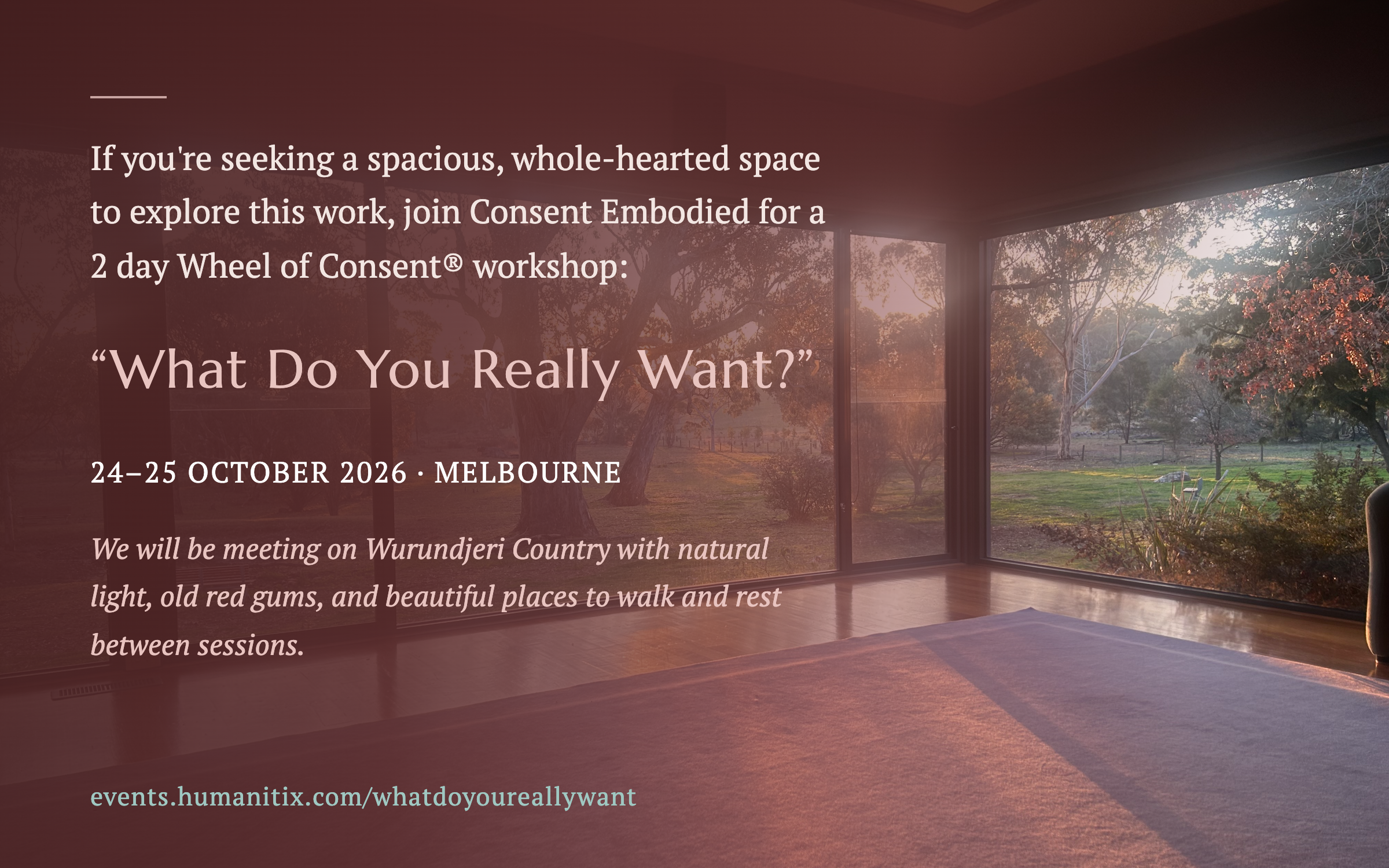
In the Wheel of Consent®, we are invited back inside our own skin - so that we can notice, trust and speak to the places outside our limits, to the places where choice might live, and to the places where joy and liberation truly come alive.
This helps me practice, in my own body and relationships, the world I want to live in.
Alexandra is a psychotherapist & group facilitator, and also provides supervision and reflective practice to allied health, social justice and somatic practitioners. She is the co-creator of Consent Embodied, a collaboration with Jo Watson, inspired by the Wheel of Consent®. You can learn more about Alexandra and Jo here or contact Alexandra directly on: alexandra.heynatz@gmail.com.